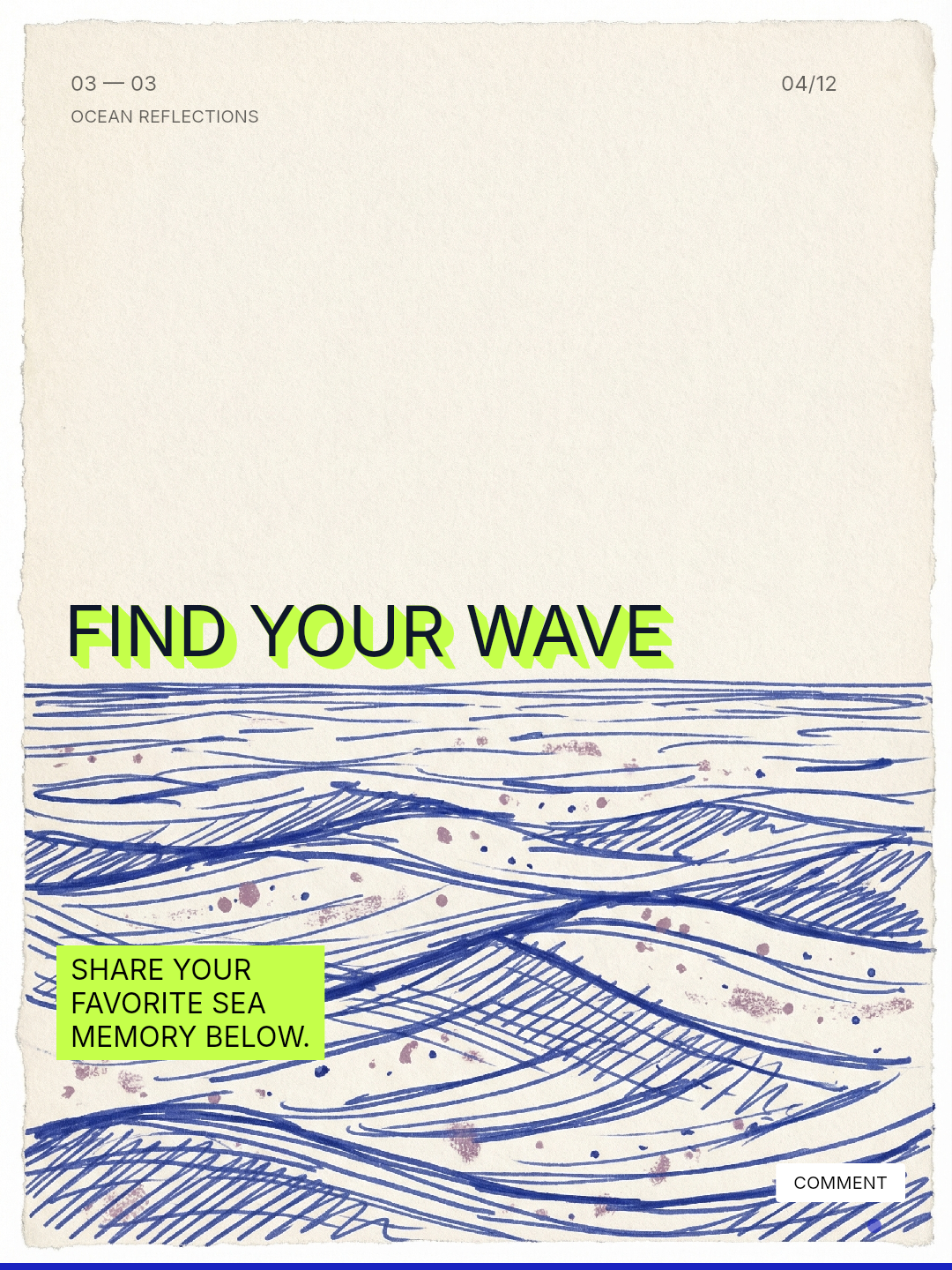
Slide one should say the one thing that makes the next swipe feel necessary. That is its job. It is not there to summarize the whole carousel, prove the claim, and deliver the conclusion. It only needs to create a strong enough promise that the audience wants to continue.
Many weak carousels fail because the cover is trying to do too much. It becomes vague, cluttered, or abstract. A better cover is specific, readable, and slightly incomplete in the best way: it tells the audience enough to care and leaves enough unresolved to keep swiping.
The cover should promise a payoff
A good slide one creates tension between what the reader knows now and what they will know if they continue. That tension can come from a sharp claim, a useful question, a surprising reframe, or a concrete problem.
Examples of strong cover promises include:
- “People save clarity.”
- “Why your carousel looks generic.”
- “The slide-one mistake that kills engagement.”
These lines do not explain everything. They create curiosity with direction.
Keep it to one dominant read
If the audience has to choose between three headline ideas on the cover, the cover is already weaker. One dominant read almost always wins over several medium-strength ones.
This is one reason the best carousel design starts with message discipline before layout exploration. The cover gets better when the idea gets clearer.
Match the promise to the sequence
A strong hook is useless if the rest of the carousel does not deliver on it. Slide one should create the right expectation for what comes next. If the carousel is tactical, the cover should feel practical. If the carousel is strategic, the cover can be broader or more provocative.
This is where many creators miss. They write a hook for attention, then deliver a different type of post after the swipe. That disconnect hurts trust even if the cover performs well.
Useful cover formulas
These formulas work because they create a clear next step for the audience:
- Mistake + consequence: “Why your carousel gets ignored.”
- Claim + payoff: “Better visuals increase saves.”
- Tension + resolution: “Consistency is a system, not a reminder.”
- Process + outcome: “Turn one idea into a full carousel.”
The exact wording can change, but the structure stays useful.
If the rest of the carousel still feels muddy after writing a strong cover, the issue is often the sequence itself rather than the hook. In that case, it helps to break the idea into clearer beats before polishing the design.
Test the cover before polishing the rest
A practical production habit is to write three possible cover lines before you finish the sequence. Choose the strongest one, then let the later slides support that promise. This saves time because the post is being built around a sharper opening from the start.
You can also learn from performance patterns. If posts with stronger, narrower promises consistently outperform broad covers, you have a useful editorial signal to keep.
FAQ
Should slide one be a question or a statement?
Either can work. Use a question when the audience clearly recognizes the problem. Use a statement when the claim itself is strong enough to stop the scroll.
How long should the slide-one headline be?
Short enough to read instantly and specific enough to create a payoff. If the line needs too much explanation, it probably belongs in slide two, not in the cover.
Final takeaway
Slide one should make one compelling promise, not perform the entire carousel alone. When the cover creates the right tension and the sequence fulfills it, the whole post becomes easier to read and more persuasive to follow.
Leya helps creators shape that opening with more intention by keeping the message, layout logic, and sequence structure connected from the first slide onward.